Glow Worms In Australia: Where They Live And How To See Them
Australian glow worms are the larvae of a native fungus gnat, and the best documented colonies within reach of Sydney sit in the Blue Mountains and Wollemi National Park.
Short answer
Australia's glow worms are the larvae of the fungus gnat Arachnocampa richardsae, a native insect whose blue-green glow lures prey into silk snares. The colonies documented near Sydney are in Wollemi National Park's Glow Worm Tunnel, about 2.5 hours away by road, and on a guided night hike from $128 USD per person.
Glow worms are not worms at all. They are the larval stage of a small native fly, and the light they produce is a trap: a blue-green lure that pulls insects into sticky silk threads strung across the dark. Australia is one of the very few countries where these animals live, and the colonies documented in the Blue Mountains and Wollemi National Park are among the most accessible anywhere in the country. For anyone planning a trip around these colonies, our guide to seeing glow worms in NSW covers the best viewing spots and what to expect once you arrive.
This guide covers what an Australian glow worm actually is, where the documented colonies sit, how close they are to Sydney, and the honest options for seeing them, from a free self-guided walk to a small-group night hike with hotel pickup. The sources throughout are NSW National Parks, the Bureau of Meteorology and the operators' own pages.
What Exactly Is An Australian Glow Worm?
An Australian glow worm is the larva of a fungus gnat, Arachnocampa richardsae, a native insect whose transparent rear end produces a blue-green bioluminescent light used to lure prey into silk snares. The larval stage lasts 6 to 9 months, while the adult fly lives only about 3 days. NSW National Parks documents the species in Wollemi National Park.
The name is a misnomer that has stuck for more than a century. NSW National Parks is direct about it: glow worms are "the larval life stage of small flying insects", and in their adult form they are fungus gnats, delicate flies that never eat and live roughly three days, long enough only to mate and lay eggs. The glowing thing visitors travel to see is the juvenile, a grub-like larva that spends six to nine months in its worm-like stage, spinning a nest and hanging silk snares from it. The snares are fishing lines, essentially: small flying insects such as mosquitoes and moths follow the light, stick to the thread, and are hauled in and eaten. The NPWS story from Wollemi notes larvae can trap bugs as big as a cockroach.
The light itself comes from the transparent rear end of the larva, a chemical reaction NSW National Parks describes as bioluminescence. The story from Wollemi calls it "hundreds of blue-green tail lights". One detail matters enormously for anyone planning a visit: the animals control their own lights and will switch them off if disturbed, which is why torch discipline and quiet matter so much on site.
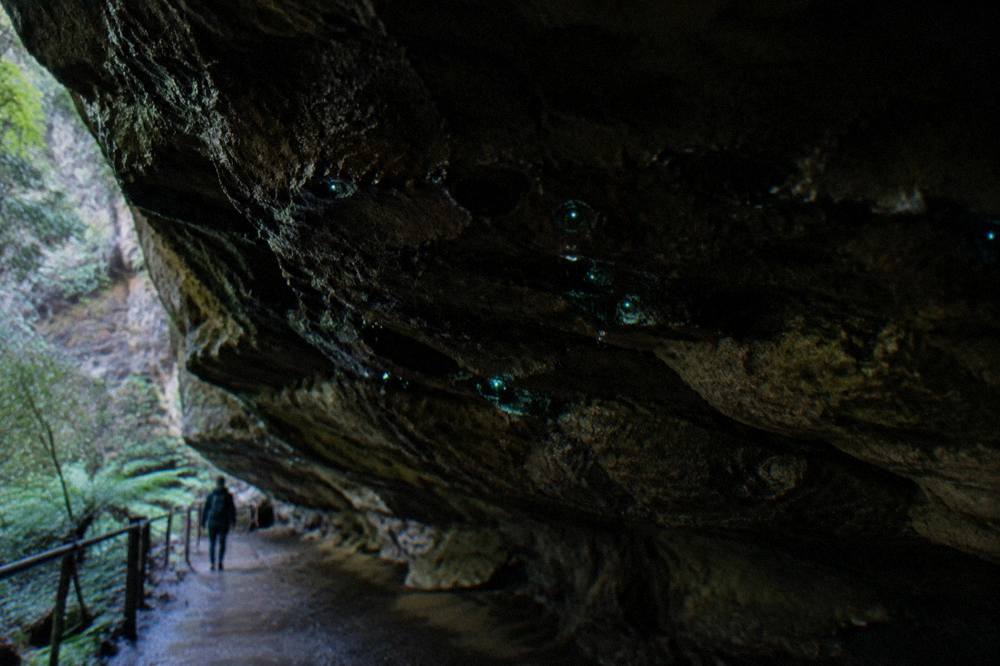
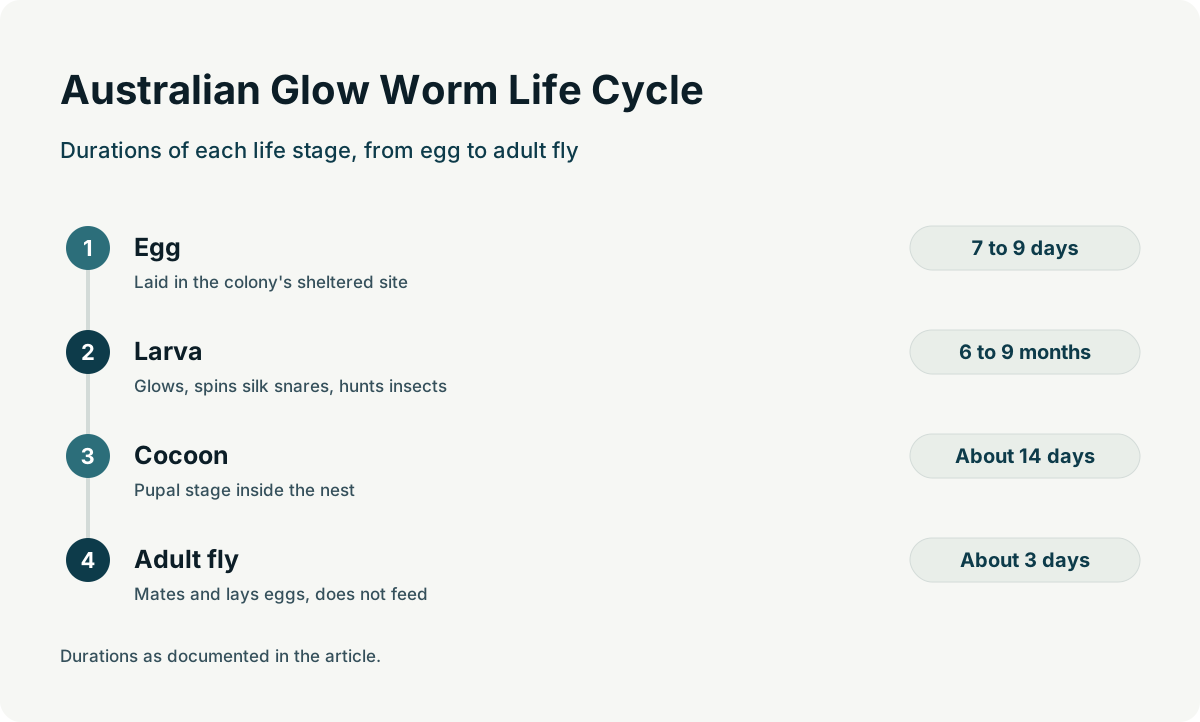
The life cycle is short at both ends and long in the middle. Eggs hatch in 7 to 9 days, the larva glows and hunts for 6 to 9 months, the cocoon stage runs about 14 days, and the adult fly survives around 3 days. That long larval stage is the reason colonies persist in stable, sheltered places, and why a disused railway tunnel in Wollemi National Park holds a permanent population. The habitat requirements are specific: darkness, still humid air, shelter from weather and running water nearby as a food source. Caves, overhangs, rainforest gullies and abandoned tunnels all fit, and the Blue Mountains region holds many colonies, mostly in caves and disused mines.
| Life stage | Duration | What happens |
|---|---|---|
| Egg | 7 to 9 days | Laid in the colony's sheltered site |
| Larva | 6 to 9 months | Glows, spins silk snares, hunts insects |
| Cocoon | About 14 days | Pupal stage inside the nest |
| Adult fly | About 3 days | Mates and lays eggs, does not feed |
The species found in the Blue Mountains and Wollemi is Arachnocampa richardsae, named on the NSW National Parks animal page and on the Wollemi National Park learn-more page. The genus Arachnocampa is shared with New Zealand, which is why glow worm tourism in those two countries, and nowhere else on this scale, is built around the same biology. For more on the animal itself, the site's species guide goes deeper: see what these glowing larvae actually are.
How Close To Sydney Are Australia's Glow Worms?
The nearest well documented glow worm site to Sydney is the Glow Worm Tunnel in Wollemi National Park, about a 2.5 hour drive away near Lithgow, with no public transport to the carpark. Within the Blue Mountains proper, the bookable option is a guided night hike from Sydney with hotel pickup, from $128 USD per person, rated 4.9 from 210 reviews.
Start with the honest geography. There is no glow worm tunnel in Sydney itself, and NPWS and operator pages do not describe one. The nearest documented tunnel colony is the Glow Worm Tunnel in Wollemi National Park, which NSW National Parks describes as "just a 2.5hr drive from Sydney". Katoomba, the heart of the Blue Mountains, is about 1.5 to 2 hours from Sydney by road and about 2 hours by regular daily train from Sydney Central. Beyond Katoomba there is no public transport to the tunnel carpark: access is by private vehicle on unsealed gravel roads, and NSW National Parks recommends a 4WD, with 4WD access only in wet weather.
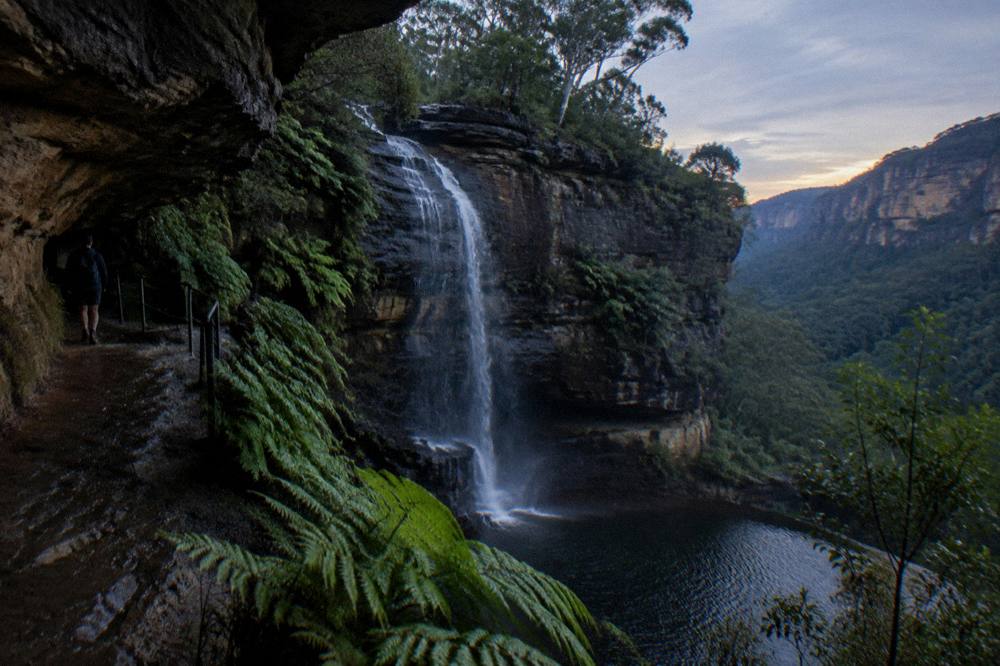
That leaves two realistic ways to see Australian glow worms without owning a 4WD. The first is the free self-guided walk to the Glow Worm Tunnel, described in the next section. The second is a small-group guided night hike that collects guests from Sydney accommodation in the evening, drives into the Blue Mountains, and walks by headlamp to a cave behind a waterfall where native glow worms live. The listing puts the price from $128 USD per person, the group at a maximum of 9 travellers, and the rating at 4.9 from 210 reviews. It is the one bookable glow worm product this site covers in depth.
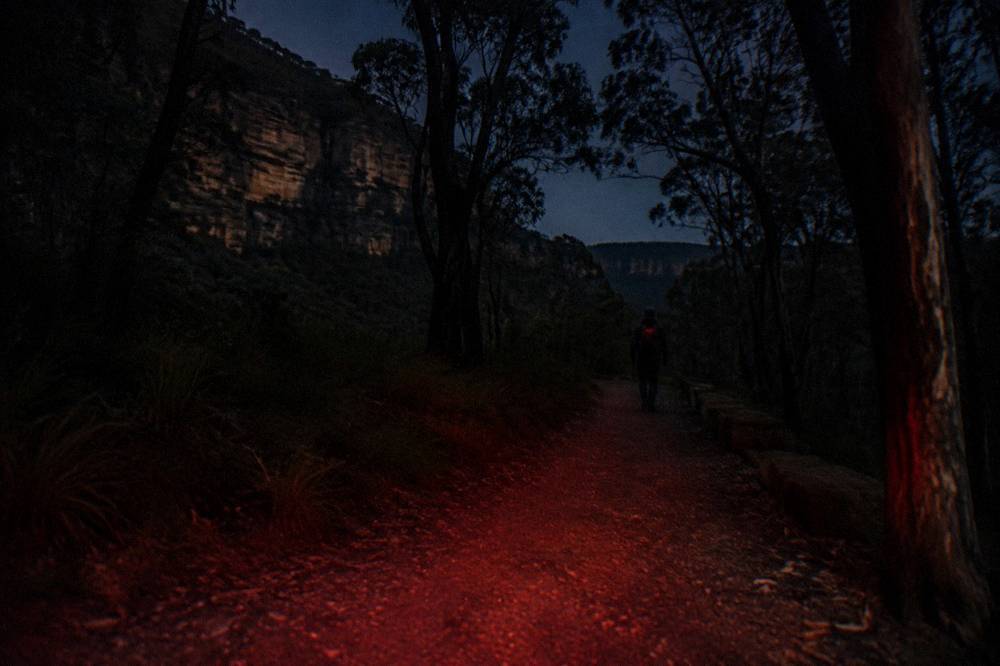
The distinction matters because the two experiences are genuinely different places. The hike does not go to the Glow Worm Tunnel at Newnes, and the operator does not publish the cave's location. What the listing describes is a guided bush walk in the dark, headlamps in red-light mode, to a cave with a waterfall where glow worms can be seen, with a chance of other local wildlife along the way. Transport in a small van, parking fees, water and a certified outdoor instructor are included, and the operator cancels for bad weather or if minimum numbers are not met. Glow worms are wild animals, so no honest operator guarantees a sighting, but the cave holds a resident colony and the operator runs the walk year round.
For readers weighing the two, the site compares them directly in self-drive versus guided options for the tunnel and in the guide to night versus daytime glow worm viewing.
Where Is The Famous Glow Worm Tunnel?
The Glow Worm Tunnel is a 387 metre disused railway tunnel in Wollemi National Park near Lithgow, reached by a 6 km return walking track from the carpark at the end of Glowworm Tunnel Road. NSW National Parks lists the track as open with current alerts to check, and no entry fee is listed.
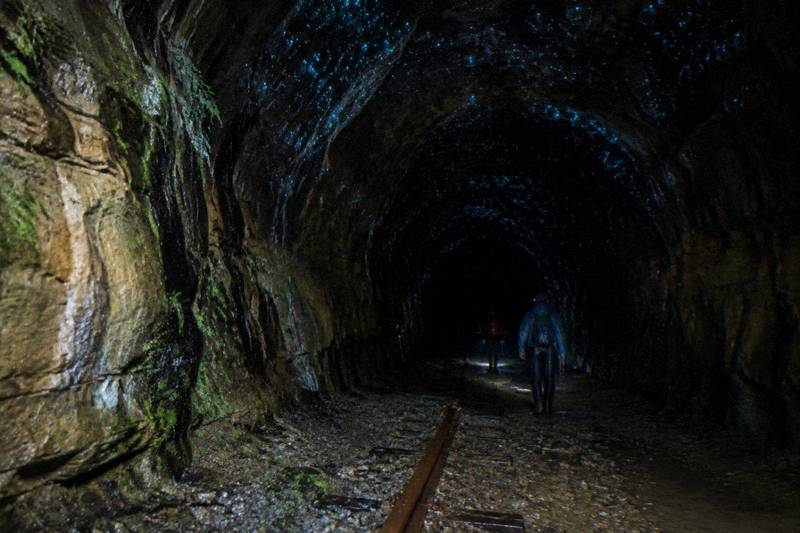
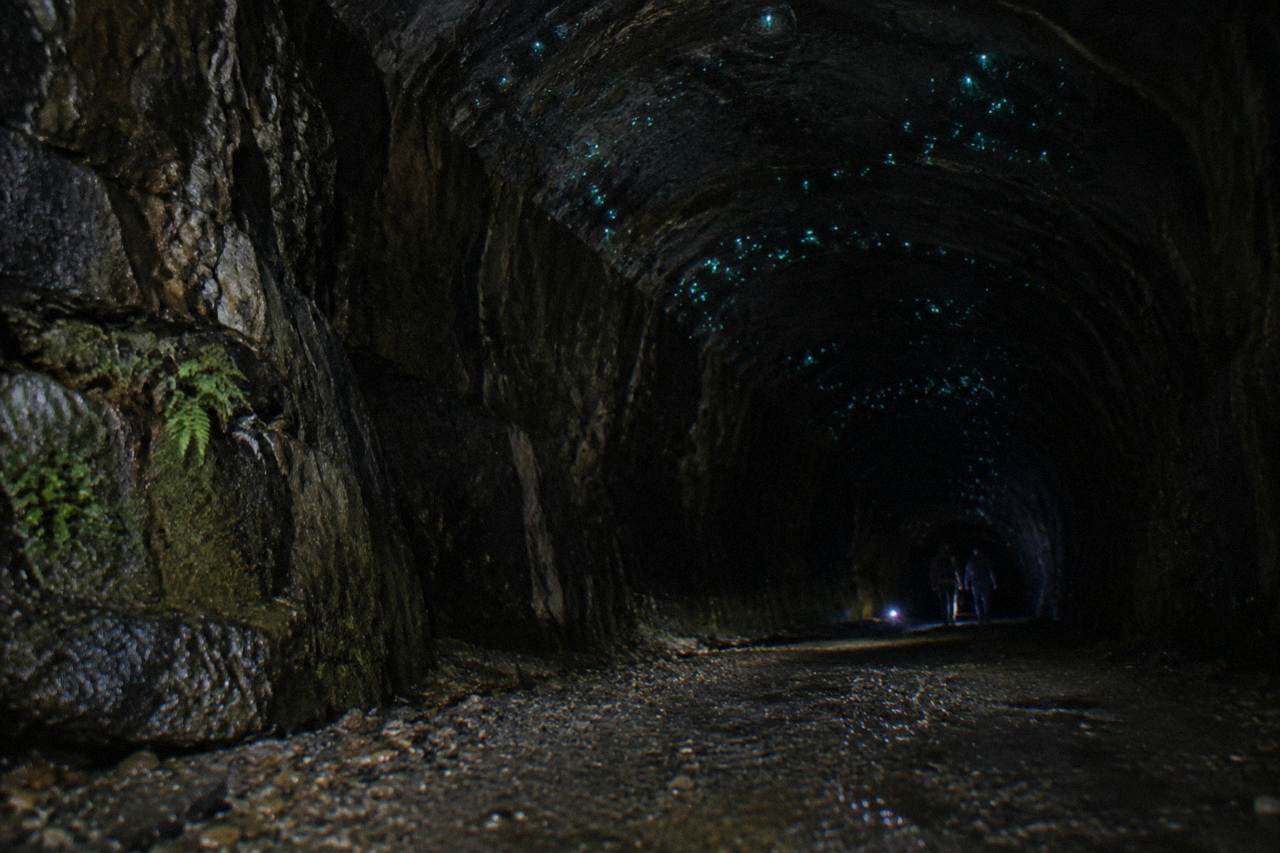
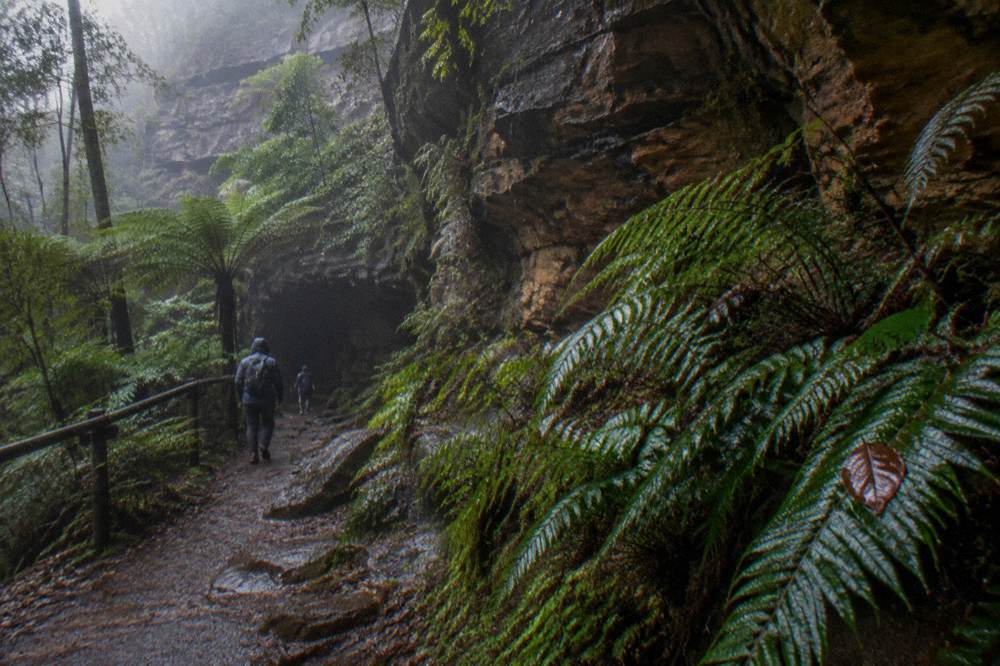
The tunnel was built in the early 1900s for the Newnes mining railway, part of the Wolgan Valley Railway, and carries the unglamorous official name Tunnel No. 2. When the railway closed, the darkness and constant humidity inside made it near-perfect glow worm habitat, and a permanent colony moved in. Because the tunnel is long, it gets dark enough to see the glow worms during the day, which is unusual: most glow worm viewing elsewhere requires full night. NSW National Parks says the tunnel is pitch black inside and the colony can be seen on a daytime visit.
The walk itself is graded Grade 3 with some bushwalking experience recommended. From the carpark it is 1.5 km to the tunnel entrance, and the full 6 km return track continues through Penrose Gorge to a lookout over Donkey Mountain and the Wolgan Valley. There are over 80 steps without handrails, a pinch point about 0.5 m wide, and an uneven, sometimes wet tunnel floor. There is no wheelchair or pram access, no drinking water, and very limited mobile reception, so the Emergency Plus app is advised. Facilities are two non-flush toilets and a timber bench.
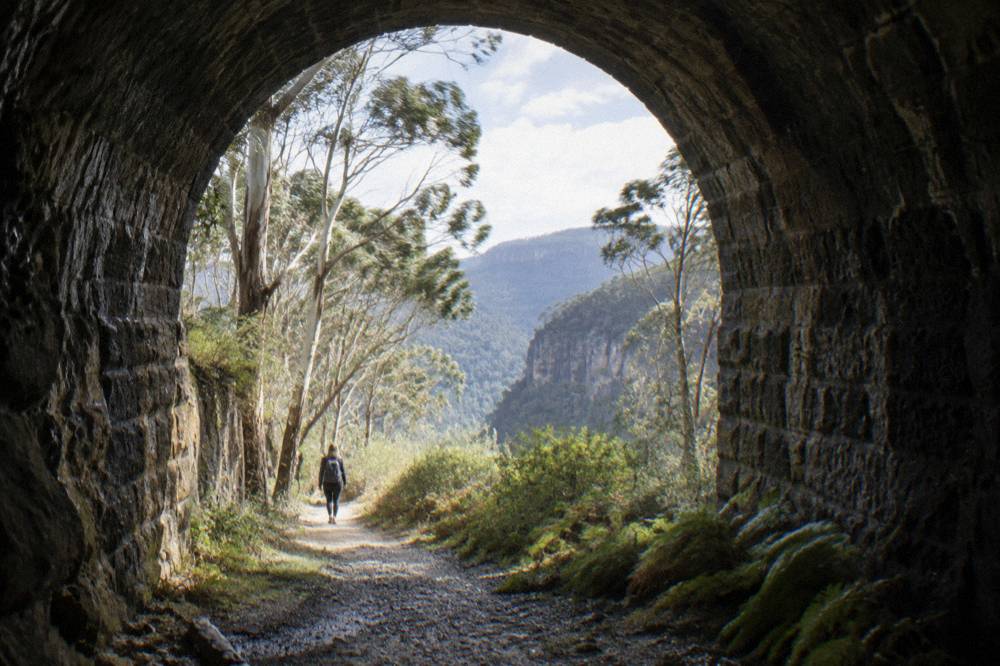
Access is the part that catches visitors out. The route from Lithgow runs via Clarence and the Zig Zag Railway, then along Old Bells Line of Road and 26.8 km of Glowworm Tunnel Road, unsealed gravel for most of the way, passing through a 60 m single-lane tunnel just before the carpark. A 2WD is possible in dry weather, a 4WD is highly recommended, and in wet weather access is by 4WD only. Trucks frequently use Old Bells Line of Road. Parking at the end is limited, and NSW National Parks says it is best to visit during the week or in spring or autumn because summer, weekends and holiday periods get very busy.
| Access detail | What the official pages say |
|---|---|
| Drive from Sydney | About 2.5 hours |
| Track | 6 km return, Grade 3, 2 to 3 hours suggested |
| Tunnel length | 387 m, dark enough for daytime viewing |
| Road type | Unsealed gravel, 4WD recommended, 4WD only when wet |
| Parking | Limited at peak times |
| Entry fee | None listed on the NPWS pages |
| Public transport | None to the carpark |
Two current works are worth checking before any trip. Construction at the Bungleboori precinct runs until December 2026 and the Bungleboori site itself is closed to visitors, while Glowworm Tunnel Road at the intersection with Lost City North and Maiyingu Marragu is reduced to a single lane from 11 October 2026 with delays of up to 5 minutes. A park fire ban applies across Wollemi National Park from 1 October 2026 to 31 March 2027. None of these close the tunnel track itself, but the alerts page changes weekly and should be re-read before setting out, a habit the site covers in whether the tunnel is open right now.
For travellers who would rather not drive gravel roads at all, the guided night hike from Sydney is the alternative that skips the self-drive entirely.
The listing is flagged as often selling out, which is the operator's own note. Free cancellation applies up to 24 hours before, and the operator cancels and refunds if weather or minimum numbers force a change, so booking ahead carries little risk.
What Does The Guided Night Hike From Sydney Involve?
The guided night hike is an evening small-group bush walk, maximum 9 travellers, that picks up from Sydney accommodation between about 7:50pm and 8:35pm and returns around 11pm to midnight. It costs from $128 USD per person, includes transport, headlamps in red-light mode, parking fees, water and a certified outdoor instructor, and requires moderate fitness.
The pickup window is staggered across Sydney hotels rather than a single fixed meeting point, which is why the times run from about 7:50pm to 8:35pm. From there the listing describes a drive into the Blue Mountains, then a guided bush walk in the dark using headlamps switched to red light, the least disruptive mode for the animals. The destination is a cave with a waterfall where native glow worms can be seen, plus a chance of spotting other local wildlife on the walk. The whole outing runs about 5 hours.
It is not a tunnel walk, and it is not wheelchair accessible. The operator rates it as requiring moderate fitness, and the small group cap of 9 keeps the noise and light footprint low, which is exactly what glow worm viewing demands. The meal situation is not settled between booking sources, so treat dinner as unconfirmed and eat beforehand. English is the tour language, and the operator is Wildscape Adventures.
Compared with the free tunnel walk, the trade-offs are straightforward. The tunnel is free, viewable in daylight and reachable by anyone comfortable on gravel roads, but it demands a long drive and there is no guide. The hike costs from $128 USD per person but removes the driving, supplies the red-light gear, and puts a certified instructor between the group and the bush at night. For readers deciding purely on cost, the breakdown in what it costs to go through the tunnel covers the free option in detail.
When Is The Best Time To See Glow Worms In Australia?
Glow worms are present year round, and NSW National Parks suggests visiting during the week or in spring or autumn to avoid crowds and limited parking. No official source ranks months by brightness; operators and travel press say displays are often stronger in warm, wet months and after rain, which is opinion, not data.
The year-round presence is the key fact, and it holds for both the tunnel and the wider Blue Mountains. The 387 m tunnel is dark enough inside that the colony glows during the middle of the day, in any season. Winter visits remain viable and are often quieter, though Katoomba's mean minimum temperature falls to 2.6 degrees in July, so the self-guided walk in winter means cold nights and frost on the plateau.
On the seasonal claims, honesty requires a label. Operators and the travel press say displays are often strongest in the warmer, wetter months, especially December to March, and that rain increases how many larvae glow and how brightly, while moonlight inhibits output. No official source ranks months, so treat all of that as operator and press opinion. What can be stated from Bureau of Meteorology statistics for Katoomba, at 1,017 m elevation, is the rainfall and temperature pattern, which readers can weigh against that opinion themselves.
| Month | Mean minimum temp (C) | Mean rainfall (mm) |
|---|---|---|
| January | 12.9 | 164.9 |
| February | 13.0 | 177.8 |
| March | 11.6 | 174.6 |
| April | 8.8 | 121.9 |
| May | 6.1 | 100.3 |
| June | 3.7 | 116.0 |
| July | 2.6 | 84.9 |
| August | 3.3 | 79.3 |
| September | 5.5 | 70.7 |
| October | 7.8 | 91.5 |
| November | 9.9 | 110.3 |
| December | 11.8 | 120.4 |
The numbers come from the Bureau of Meteorology's long-term climate averages for the Katoomba (Farnells Rd) station. The wettest months are February and March, at 177.8 mm and 174.6 mm respectively; the driest are August and September; and the mean minimum never drops below freezing on average, though individual winter nights well and truly do. Anyone chasing the operator-endorsed "after rain" effect will notice the plateau is rarely dry for long. The site unpacks the seasonal question further in the best time to see glow worms.
How Should You Behave Around Glow Worms?
NSW National Parks asks visitors to stay on the path, keep noise to a minimum, let eyes adjust in the dark, and shine torches only at the ground or use a red-light mode. Never point a torch at the glow worms, since it can damage their bioluminescence and makes them switch their lights off, and look but do not touch. If you're curious why even a light touch can harm them, the reasons you can't touch glowworms explain how their lights and silk snares respond to disturbance.
The etiquette is not fussiness, it is physics and biology working together. The larvae switch their lights off when disturbed, so a white torch beam or a loud voice can blank out the display for the whole group and leave it dim for some time after. NSW National Parks is explicit that glow worms "can control their lights and will turn them off if disturbed", and its Wollemi story adds that pointing a torch at them can damage the bioluminescence itself. The practical rules are simple: red light where possible, torch beams aimed at the ground, voices down, feet on the track.
No flash photography rule was found on any NPWS page, so this guide does not state one either. What the pages do say covers everything that actually matters: stay on the path, minimum noise, eyes given time to adjust once the torch goes off. The guided hike supplies headlamps with a red-light mode as standard, which removes the guesswork. Visitors photographing the colony will find the practical and ethical considerations in glow worm tunnel photography, and families can read the age and safety angles in taking kids to the tunnel.
Prohibited activities at the tunnel are listed plainly by NSW National Parks: no camping, no cycling on the track or in the tunnel, no pets other than assistance animals, and no smoking. The nearest campground is Newnes, reached via Wolgan Valley Road. The wider safety picture, from the unsealed roads to the steps without handrails and the poor mobile reception, is gathered in the site's tunnel safety guide.
For anyone who wants the guided version of these rules applied for them, the night hike builds them in.
Are There Glow Worms Elsewhere In The Blue Mountains?
NPWS and operator pages do not describe glow worms at Jenolan Caves, the Grand Canyon Track, Govetts Leap, Wentworth Falls, Leura or Blackheath. The documented sites are the Glow Worm Tunnel in Wollemi National Park and the private canyon and overhang colonies reached by guided tours, including the waterfall cave on the night hike.
Glow worm lists circulate online naming half the Blue Mountains, but the official sources this site relies on do not support them. The Jenolan Caves official site makes no mention of glow worms anywhere in its cave descriptions or wildlife sections, and no tour listing found for Jenolan mentions them either. The NPWS page for the Grand Canyon Track at Blackheath, a 6.3 km Grade 3 loop taking 3 to 4 hours, says nothing about glow worms. The same absence holds for Govetts Leap, Wentworth Falls, Leura and Blackheath generally.
What the sources do support is a region with many colonies, mostly in caves and disused mines, on private and remote country that is not signposted for the public. That is why guided access exists at all. The night hike from Sydney visits a glow worm cave behind a waterfall, and the operator keeps the location unpublished. A handful of other operators run or ran tunnel and overhang tours from the Blue Mountains: Beyond The Blacktop's own page lists a guided tunnel tour at $210 adult, child $159, senior $189, with a $275 adult version including Dry Canyon, currency not stated, departing Katoomba Station or the Zig Zag Railway at Clarence over about 5 hours with no Sydney hotel pickup. Smaller Bilpin-area operators exist, but their status varies and their prices are not verified here.
The one site often confused with all of this is Helensburgh, an old rail tunnel in the Illawarra south of Sydney. No NPWS, council or museum page describing a glow worm tunnel there was found, a past tour listing for it was not live, and it is a different place from the Wollemi tunnel in any case. The site covers the comparison properly in Helensburgh versus Newnes, and readers considering it should confirm access with the local council before going anywhere. For the broader state picture, where to see glow worms in NSW keeps to the documented sites only.
Which Australian Glow Worm Experience Should You Book?
Book the Sydney-pickup night hike if you want glow worms without driving unsealed roads at night: from $128 USD per person, 4.9 from 210 reviews, maximum 9 travellers, free cancellation up to 24 hours before. Self-drive the free tunnel walk if you have a suitable vehicle and want the historic 387 m tunnel on your own schedule.
The decision comes down to transport and confidence. The tunnel walk costs nothing and shows a genuinely spectacular colony in a piece of industrial heritage, but it puts the driver on 26.8 km of gravel and the group on an unlit track, and in wet weather a 4WD is required, not preferred. The night hike costs from $128 USD per person and removes every one of those variables: hotel pickup between about 7:50pm and 8:35pm, a certified outdoor instructor, red-light headlamps supplied, and a return to Sydney around 11pm to midnight. Both are weather dependent, both are honest about that, and neither guarantees a sighting of a wild animal.
Families should note the tunnel track beyond the lookout is not suitable for children, and the hike requires moderate fitness and is not wheelchair accessible. Solo travellers and couples without a car will find the hike the only realistic option. Groups with a 4WD and a daylight itinerary may prefer the tunnel, since it glows inside even at midday. Whichever way the decision falls, the month-by-month ribbon on the homepage and the full guide to booking a glow worm tour walk through the practical steps.
The night hike remains the one bookable, Sydney-pickup way to see glow worms in the dark, and the listing carries the operator's own note that it often sells out.
Common Questions About Glow Worms In Australia
Are glow worms native to Australia?
Yes. The species documented in the Blue Mountains and Wollemi National Park is Arachnocampa richardsae, a native fungus gnat larva named on NSW National Parks' own animal pages. The genus is shared with New Zealand, which is why large glow worm displays are an Australian and New Zealand phenomenon.
Can you see glow worms during the day?
At the Glow Worm Tunnel, yes. NSW National Parks says the 387 m tunnel is long enough to be pitch black inside, so the colony glows during daylight hours. Elsewhere, such as the waterfall cave on the night hike, viewing happens after dark, and eyes need time to adjust once torches go off.
How rare is it to see a glow worm?
Not rare in the right habitat, but very localised. The Blue Mountains region holds many colonies, mostly in caves and disused mines, and the Wollemi tunnel holds a permanent one. Outside those sheltered, humid, dark sites, sightings are uncommon, which is why the documented locations draw visitors.
What does a glow worm turn into?
A small flying fungus gnat. The larva spends 6 to 9 months glowing and hunting, spends about 14 days in a cocoon, then emerges as an adult that lives roughly 3 days, long enough only to mate and lay eggs.
Why can't you touch glow worms?
Because they switch off when disturbed, and contact can damage them. NSW National Parks' guidance is look but do not touch, keep noise down, stay on the path, and shine torches only at the ground or in red-light mode, since light pointed at the larvae can damage their bioluminescence and makes them turn their lights off.
Is there a glow worm tunnel in Sydney?
No. The nearest documented tunnel colony is the Glow Worm Tunnel in Wollemi National Park near Lithgow, about a 2.5 hour drive from Sydney, with no public transport to the carpark. The Helensburgh tunnel sometimes named online is in the Illawarra south of Sydney, and no official page was found describing it as a glow worm site.