What Is Special About The Blue Mountains In Australia?
The Greater Blue Mountains World Heritage Area, its glow worm colonies, its cool mountain climate and its ancient plants, explained from official sources.
What Is Special About The Blue Mountains In Australia?
The Blue Mountains hold one of the most unusual combinations in Australia: a World Heritage listed sandstone plateau an easy drive from the country's largest city, a plant that survived from the age of dinosaurs, and native glow worms that light up caves and abandoned railway tunnels. NSW National Parks describes the Wollemi pine, the region's most famous plant, as growing in a remote rainforest canyon inside the Greater Blue Mountains World Heritage Area, discovered as recently as 1994.
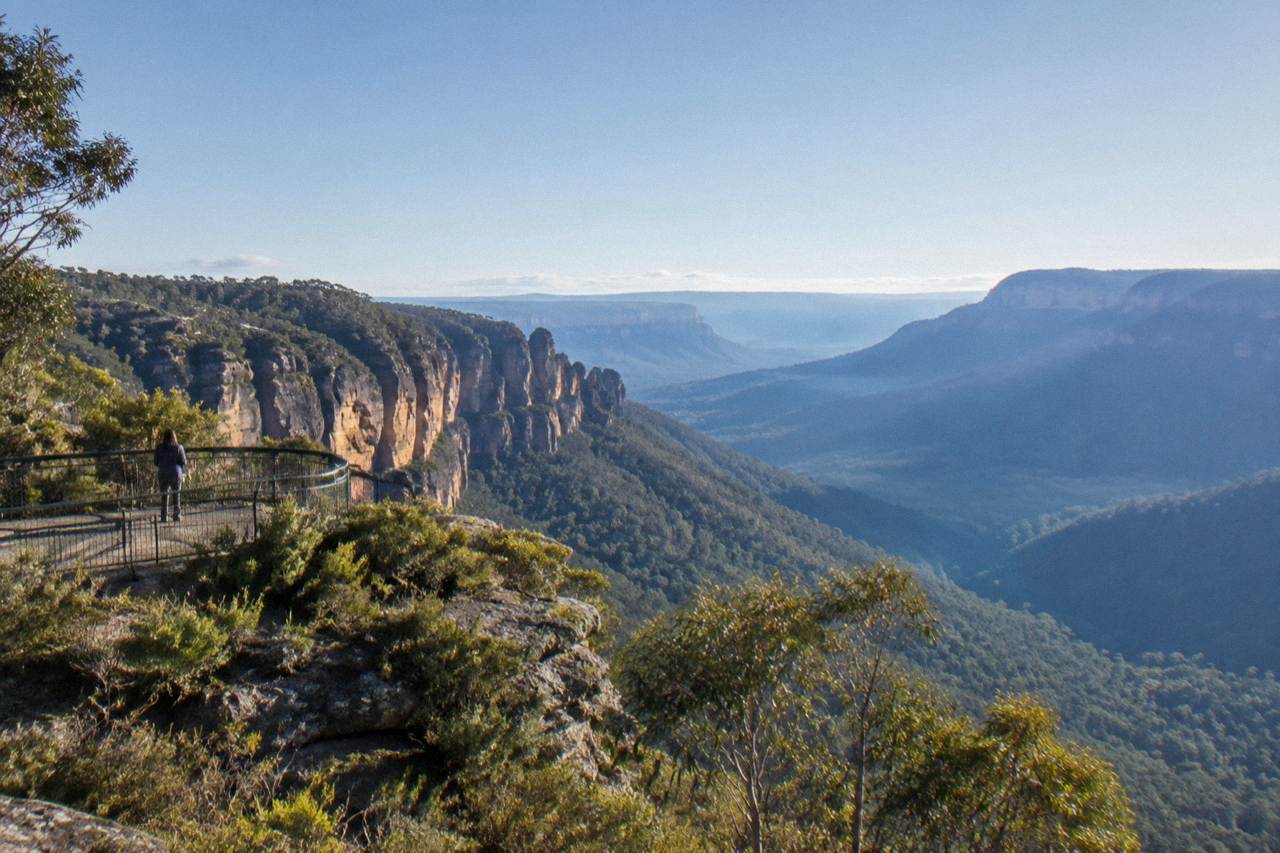
That single sentence carries most of the answer, but each part deserves its own room. The Greater Blue Mountains World Heritage Area is not one park but a cluster of eight protected areas west of Sydney, anchored by Blue Mountains National Park and taking in Wollemi National Park, the Gardens of Stone and the Jenolan Karst Conservation Reserve. The plateau rises above the Sydney basin in layered sandstone, and the eucalypt forest that covers it is so extensive, and so varied across altitude and soil, that UNESCO listed the area partly for its diversity of eucalypt species. The blue haze that gives the range its name is real: fine oil droplets from those eucalypts scatter light and tint the distant ridges.
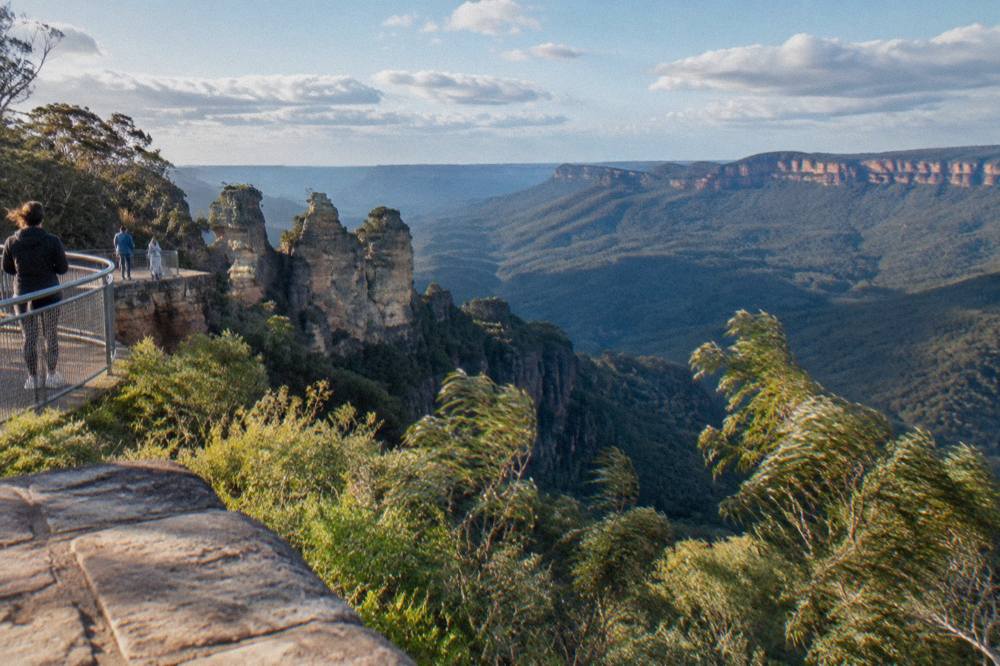
The region is also unusually accessible. NSW National Parks puts Katoomba, the main town, about 1.5 to 2 hours from Sydney by road, and about 2 hours by regular daily train from Sydney Central. Very few World Heritage areas sit that close to a city of five million people, and the combination shapes everything about visiting: crowds on summer weekends, limited parking at the popular lookouts, and a steady stream of day trippers alongside dedicated bushwalkers.
For this site's readers, the third special ingredient matters most. The Blue Mountains region holds many glow worm colonies, mostly in caves and disused mines, according to NSW National Parks, and the most famous public colony lives in an abandoned railway tunnel in Wollemi National Park. The one bookable tour covered here, the Glow Worm Cave Night Hike From Sydney, runs from $128 USD per person, is rated 4.9 from 210 reviews, and takes small groups of at most 9 travellers by van from Sydney hotels into the dark. If seeing that blue-green light is what draws you to the mountains, it is worth comparing what a guided night hike covers against making your own way to the free tunnel.
Why Is The Greater Blue Mountains A World Heritage Area?
UNESCO inscribed the Greater Blue Mountains Area for its natural values, chiefly the outstanding diversity of its eucalypt-dominated ecosystems and the living record those forests provide of how Australian vegetation evolved. The listing also recognises rare and threatened species, none more celebrated than the Wollemi pine, which NSW National Parks says grows in a remote rainforest canyon in the Greater Blue Mountains World Heritage Area and was only discovered in 1994.
The Wollemi pine story is hard to overstate. Before 1994 the tree was known only from fossils, and was assumed extinct. A bushwalker found a small stand of strange trees in a deep, wet canyon in Wollemi National Park, and botanists later confirmed the find as a living genus new to science. The exact canyon location is kept secret to protect the wild trees, but NSW National Parks documents the discovery and the species' significance on its Wollemi pine page. A plant from the dinosaur era surviving an hour and a half from a major capital city is a genuinely rare thing, and it is one of the strongest reasons the area earned World Heritage status.
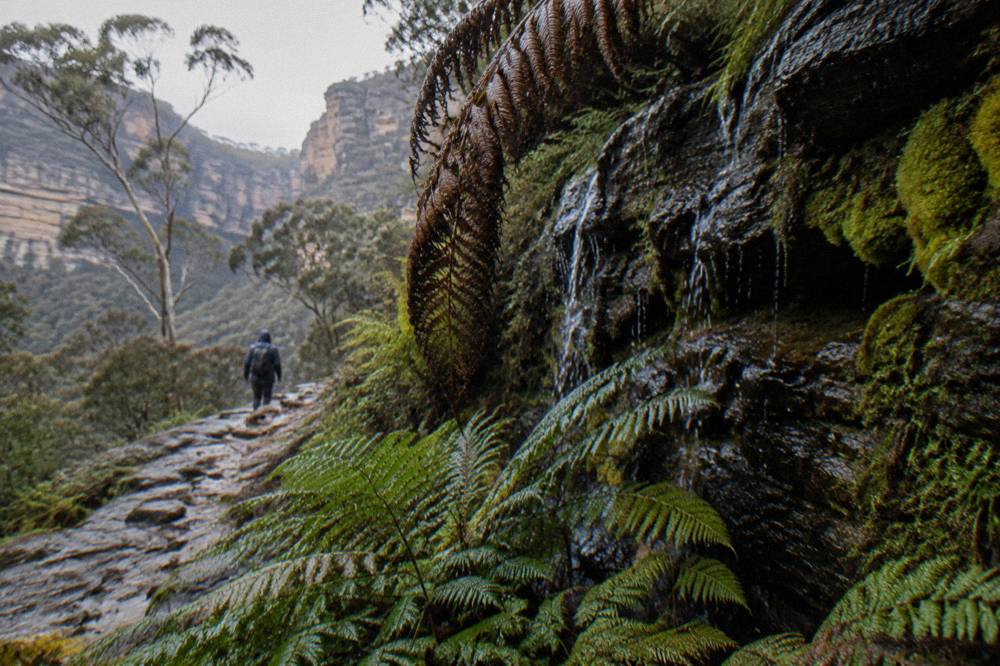
The listing covers far more than one tree. The eight reserves that make up the Greater Blue Mountains World Heritage Area protect deep gorges, hanging swamps, pagoda rock formations in the Gardens of Stone, and the limestone caves at Jenolan, one of the oldest cave systems in the world. The sandstone plateau acts as a giant water filter and reservoir, feeding the gullies and overhangs where rare plants and animals hold on. Those same sheltered, permanently damp, permanently dark places are exactly where glow worms set up their colonies, which is why the biology of this region and its glow worms are the same story told twice.
For travellers weighing how to spend a night in the mountains, the choice usually comes down to driving yourself to a free site or joining a small guided trip. Is a guided trip with hotel pickup the better fit for your plans?
What Wildlife Lives In The Blue Mountains?
The Blue Mountains shelter a cross-section of Australian wildlife across a steep altitude range, from lyrebirds and rock wallabies in the gullies to gliders and owls in the taller forest. The most remarkable resident is the glow worm, Arachnocampa richardsae, the larva of a fungus gnat that spins silk snares and lights its own rear end blue-green to lure prey, and NSW National Parks lists it among the animals found in Wollemi National Park. If you'd like to see these glowing larvae for yourself without spending much, our guide to free glow worm spots and budget Blue Mountains tips covers where to look after dark.
Glow worms are the region's least expected animal. They are not worms at all: NSW National Parks describes them as the larval stage of small flying insects, fungus gnats whose young spend 6 to 9 months in a worm-like form, glowing from a transparent rear end to attract mosquitoes and moths into sticky silk threads. After a 14 day cocoon the adult gnat lives only about 3 days, just long enough to mate and lay eggs. Because the larvae need darkness, still humid air and running water nearby, they cluster in caves, overhangs, rainforest gullies and abandoned tunnels, and the Blue Mountains region holds many such colonies, mostly in caves and disused mines.
The rest of the fauna list is more conventional but still rich. Lyrebirds, famous for their mimicry, scratch through the leaf litter on almost any walking track. Swamp wallabies and echidnas appear near the lookouts at dawn and dusk. Greater gliders and yellow-bellied gliders ride the taller forests at night, and the glow worm tour covered on this site includes a chance of spotting other local wildlife by headlamp, since the walk passes through habitat that comes alive after dark. Birdwatchers come for the range of honeyeaters, robins and the rare rockwarbler, a species found almost nowhere else but the sandstone country of the Sydney basin and the mountains at its edge. If the after-dark wildlife has you curious about what else the mountains offer once the sun goes down, the guide to fun night activities in the Blue Mountains covers everything from glow worm hikes to spotlighting walks.
A note on expectations: glow worms are wild animals, and no operator can promise a sighting. Displays vary with conditions, and tours are cancelled for bad weather or if minimum numbers are not met. The honest framing is that the Blue Mountains hold one of the most accessible glow worm colonies in Australia, and that visiting them, guided or self-driven, is one of the region's genuinely special experiences. Readers curious about the animal itself can start with our guide to what glow worms actually are.
How Cold And Wet Does The Blue Mountains Get?
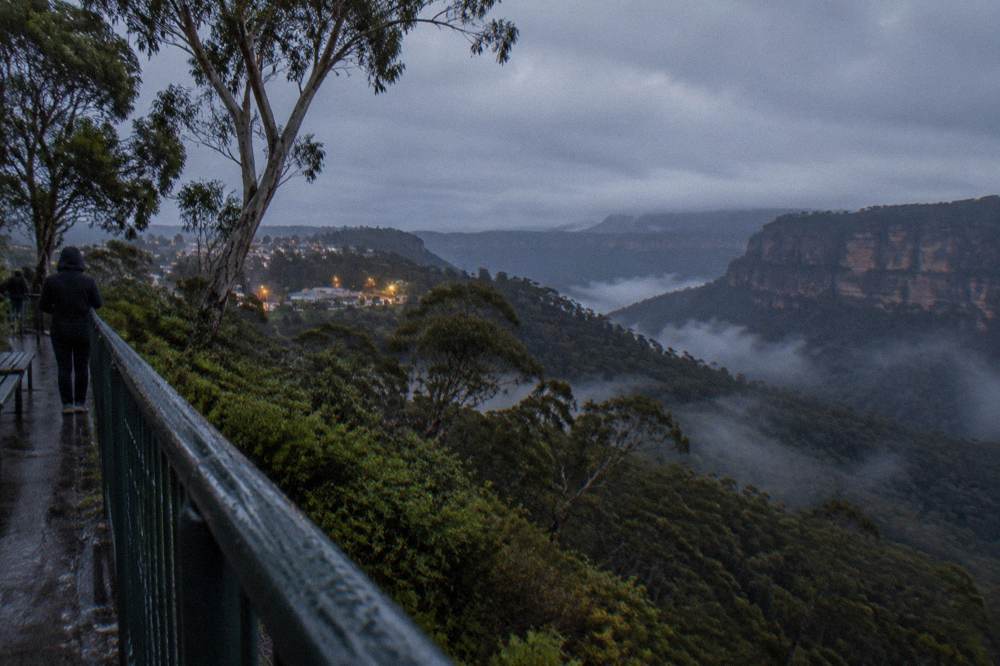
Katoomba sits at 1,017 metres elevation, and its climate is closer to a cool temperate mountain town than to Sydney. Bureau of Meteorology averages put the January mean minimum at 12.9 C and the July mean minimum at 2.6 C, with February the wettest month at 177.8 mm of rain on average. Summer days are mild, winter nights regularly approach freezing, and rain falls in every month of the year.
That elevation is the reason so many people are surprised by the mountains. Visitors leave Sydney at 25 C and step out at Katoomba into 15 C, or into fog, or into summer rain. The Bureau of Meteorology's long term averages for the Katoomba (Farnells Rd) station, published at station 063039, show how the year runs, and the pattern matters for trip planning more than almost anything else on this page.
| Month | Mean minimum (C) | Mean rainfall (mm) |
|---|---|---|
| January | 12.9 | 164.9 |
| February | 13.0 | 177.8 |
| March | 11.6 | 174.6 |
| April | 8.8 | 121.9 |
| May | 6.1 | 100.3 |
| June | 3.7 | 116.0 |
| July | 2.6 | 84.9 |
| August | 3.3 | 79.3 |
| September | 5.5 | 70.7 |
| October | 7.8 | 91.5 |
| November | 9.9 | 110.3 |
| December | 11.8 | 120.4 |
Two practical readings follow from the table. First, pack for cool nights in any season: a January evening can drop to 13 C, and a winter evening sits near 3 C, so layers are not optional on any night activity. Second, rain is a constant, with every month of the year averaging well over 50 mm, and that dampness is precisely why the region supports glow worms, rainforest gullies and the Wollemi pine: the sandstone plateaus shed water into sheltered canyons that stay wet year round. Operators and travel press say glow worm displays are often stronger in warm, wet months and after rain, which is opinion rather than official data, but NSW National Parks does advise visiting the tunnel during the week or in spring or autumn to avoid crowds and limited parking.
For anyone joining the night hike, the climate numbers translate directly: the tour supplies headlamps with a red-light mode, water and a certified outdoor instructor, and pickup from Sydney accommodation runs in a staggered window from about 7:50pm to 8:35pm, returning around 11pm to midnight per the operator. The listing is flagged as often selling out, and free cancellation applies up to 24 hours before.
Where Do Glow Worms Fit Into The Blue Mountains Story?
Glow worms are the region's hidden signature. The Blue Mountains hold many colonies, mostly in caves and disused mines, and the most visited is the 387 m abandoned railway tunnel in Wollemi National Park, dark enough inside to show the blue-green lights even in daytime. The same conditions that make the mountains special, permanent dampness, deep sheltered gorges and darkness, are the exact habitat the larvae require.
The tunnel itself is a piece of industrial history turned wildlife refuge. It was built in the early 1900s as Tunnel No. 2 of the Newnes mining railway, a rail line that hauled shale oil out of the Wolgan Valley, and when the railway closed the darkness and dripping water made it a perfect glow worm home. NSW National Parks notes that the Blue Mountains region holds many colonies, mostly in caves and disused mines, and that the tunnel's stable conditions gave it a permanent one. A free self-guided walk reaches it, and our Glow Worm Tunnel walking track guide covers the 6 km return route in detail.
The bookable alternative is different in character. The night hike from Sydney goes to a cave behind a waterfall where native glow worms can be seen, plus a chance of other local wildlife, and the operator does not publish the cave's location. It is not a visit to the tunnel, and it is not a guaranteed sighting: glow worms switch their lights off if disturbed, which is why the tour uses headlamps in red-light mode and asks walkers to keep noise down. NSW National Parks gives the same advice for the tunnel: stay on the path, keep noise to a minimum, shine a torch at the ground or use a red light, never point a torch at the glow worms, and look but do not touch.
Choosing between the two comes down to transport and confidence. The tunnel is free, about a 2.5 hour drive from Sydney, on unsealed roads where 4WD is recommended in wet weather, with no public transport to the carpark. The hike is from $128 USD per person, picks up from Sydney hotels in the evening, and puts a certified instructor between you and the dark. Both deliver the same thing the mountains do best: a short walk from an ordinary road into a place that feels nothing like the city behind you.
Whether you drive or book, the broader region rewards the detour. Our Wollemi National Park guide maps out the rest of the park, and the month-by-month ribbon on the homepage of Blue Mountains Glow Worms tracks the seasonal questions readers ask most. The mountains' real specialness is this density of one-off things, a dinosaur tree, a light-making larva, a cool climate an hour from the coast, all inside one listed area.
Common Questions About The Blue Mountains
What Is Special About The Blue Mountains In Australia?
A World Heritage listed sandstone plateau about 1.5 to 2 hours from Sydney, home to the ancient Wollemi pine discovered in 1994, exceptional eucalypt diversity, cool mountain weather and many native glow worm colonies in caves and abandoned tunnels.
Why is it called the Blue Mountains?
Fine oil droplets released by the vast eucalypt forests scatter light and give the distant ridges a blue haze, which is where the range gets its name.
Can you see glow worms in the Blue Mountains during the day?
Yes, in the right place. The 387 m Glow Worm Tunnel in Wollemi National Park is dark enough inside that NSW National Parks says glow worms can be seen during the day. In open caves and overhangs, displays show best after dark.
Is the Blue Mountains a day trip from Sydney?
Yes. NSW National Parks puts Katoomba about 1.5 to 2 hours from Sydney by road and about 2 hours by regular daily train from Sydney Central, so a day trip is practical, though an overnight stay suits night activities like glow worm walks.
Does it snow in the Blue Mountains?
Light snowfalls occur most winters at elevation, but the reliable pattern is cold, frosty nights: Katoomba's July mean minimum is 2.6 C, and rain falls in every month of the year.