What Does A Glow-Worm Turn Into?
A glow-worm is the larva of a fungus gnat fly, and after six to nine months of glowing it pupates and emerges as a small adult fly that lives only about three days.
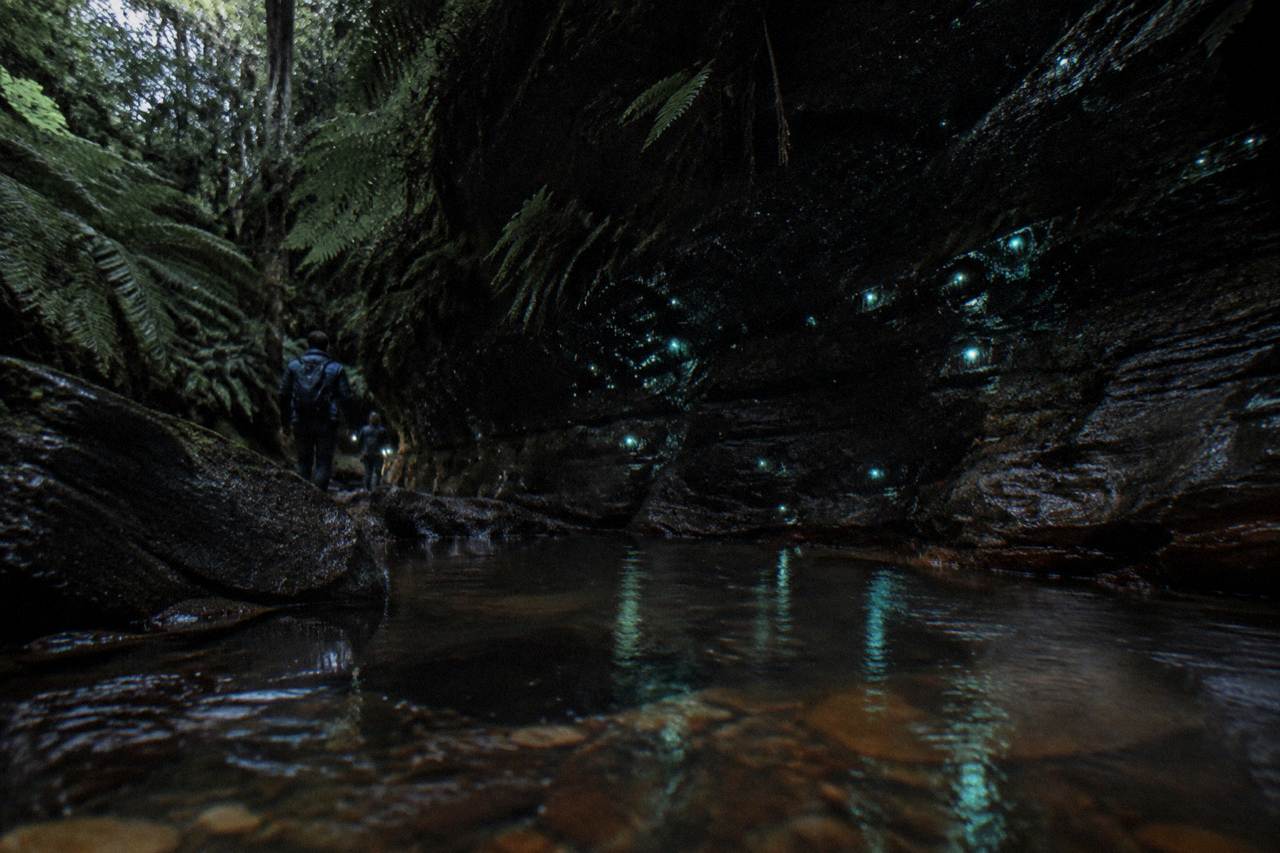
A glow-worm glowing on a wet cave wall looks like something permanent, a little lamp fixed to the rock. It is nothing of the sort. That light belongs to a larva, a juvenile insect in the middle of a life that will end within a year, and the adult it becomes does not glow at all. NSW National Parks describes the animal plainly: glow worms are the larval life stage of small flying insects, and in their adult form as fungus gnats they live just three days, with their only goals being to mate and lay eggs.
The species found in the Blue Mountains and Wollemi National Park is Arachnocampa richardsae, and the light it produces while young is a hunting tool rather than decoration. The full transformation, from egg to glowing larva to pupa to short-lived fly, runs on a timetable that NSW National Parks sets out stage by stage, and it is a stranger story than the word "worm" suggests.
What Does A Glow-Worm Turn Into?
A glow-worm turns into a small flying fungus gnat, a delicate insect in the fly family that resembles a large mosquito and lives roughly three days as an adult. The glowing stage is the larva, which spends six to nine months in that worm-like form before spinning a cocoon for about fourteen days. The adult fly that emerges has no working mouthparts for eating, does not glow, and devotes its brief life to mating and laying eggs.
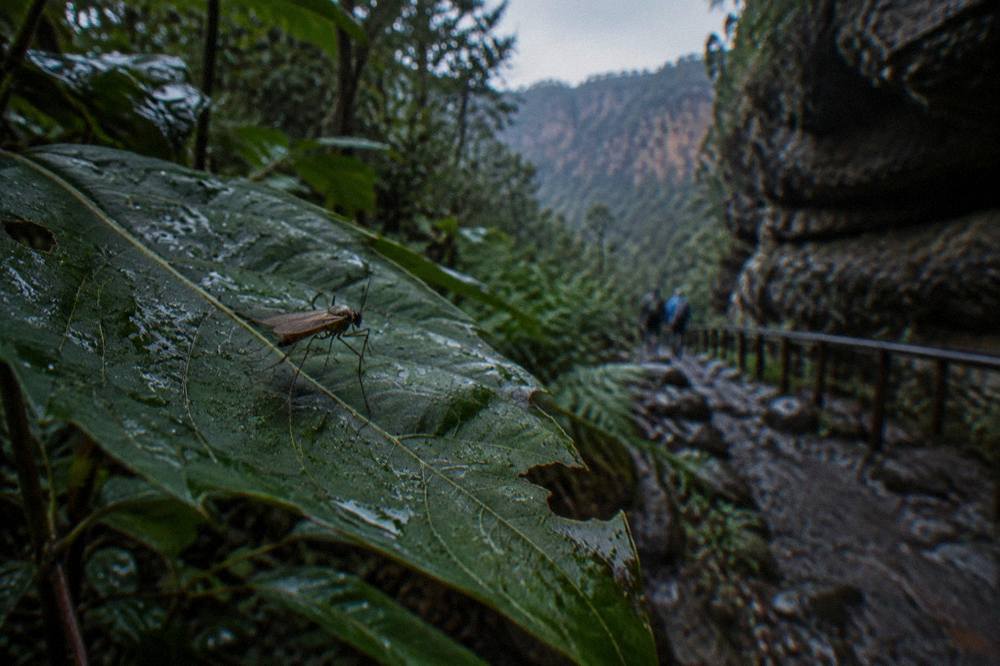
The word "worm" is the first mistake, and it is an old one. The larvae look like segmented worms with a lamp on the tail, so generations of visitors have called them glow-worms, but they are insects through and through. NSW National Parks puts the species in the fly order, in the family Keroplatidae, the fungus gnats. The adult form confirms it: a spindly, weak-flying gnat with drooping legs and translucent wings, nothing like a worm and nothing like a beetle either, despite the persistent folk idea that glow-worms are fireflies or glow beetles.
Fireflies are the second common mix-up. Australian fireflies are beetles, adults that flash to find mates, and they appear in the Blue Mountains in small numbers on warm evenings. Glow-worms are flies, and the glowing individual is a juvenile, not a courting adult. The light does different work in each animal: the beetle flashes to be seen by other beetles, while the gnat larva glows to be seen by its prey.
The transformation itself is complete metamorphosis, the same four-stage pattern butterflies use. An egg hatches into a larva, the larva grows and then pupates inside a cocoon, and the pupa reorganises into the winged adult. What makes Arachnocampa unusual is where the drama sits: nearly the whole life is the larva, and the adult is a brief afterthought. The fly does not even eat. It emerges with stored reserves, mates, scatters its eggs over a damp dark habitat, and dies within days.
That asymmetry explains why people only ever meet the larva. The adult is small, silent, hard to spot and short-lived, while the larva glows for months in fixed colonies in caves, overhangs and abandoned tunnels. When the Blue Mountains Glow Worms site talks about a colony in a tunnel or a cave, it is really talking about a nursery, a gathering of juveniles hunting in the dark.
How Long Does Each Glow-Worm Life Stage Last?
The verified timetable runs: eggs hatch after 7 to 9 days, the larva lives 6 to 9 months, the pupa rests in its cocoon for about 14 days, and the adult fly survives about 3 days. The larval stage is the glowing one and takes up nearly the whole lifespan, which is why a colony looks stable even though each individual insect is short-lived.
NSW National Parks gives each figure on its glow worm facts page, and together they sketch a life of about seven to ten months from egg to death. The egg stage is the briefest: a week to nine days after laying, depending on temperature and humidity, the larva hatches already able to produce light. From that moment the glow is switched on, and it stays on for most of the larva's long tenure (see Tunnel Walk Time).
| Life stage | Duration | What happens | Does it glow? |
|---|---|---|---|
| Egg | 7 to 9 days | Laid in clusters on damp cave or tunnel walls | Not documented |
| Larva | 6 to 9 months | Hunts insects with light and silk snares, moults through several instars | Yes, brightest stage |
| Pupa (cocoon) | About 14 days | Sealed in a silk cocoon, reorganises into the adult fly | Not documented |
| Adult fungus gnat | About 3 days | Mates and lays eggs, does not eat | No |
The pupal fortnight is the quiet hinge of the life cycle. The larva stops hunting, seals itself into a cocoon of its own silk, and its body is broken down and rebuilt as a gnat. Fourteen days later the adult pushes out, rests while its wings harden, and begins the last and shortest chapter. Three days is the figure NSW National Parks gives, and in that window the fly must find a mate and, if female, find a suitable dark, damp surface on which to lay.
Because the larva lasts so much longer than everything else combined, colonies read as permanent to a visitor. The colony in the Glow Worm Tunnel at Newnes, for instance, has been a fixture for decades, but no individual in it has. The population is a relay: new eggs hatch constantly into the dark, and the glowing juveniles replace themselves from within, while the adults flit away unnoticed at the entrance.
Why Does The Larva Glow While It Grows?
The larva glows to hunt. Its blue-green light shines from a transparent rear end and lures small flying insects, mosquitoes and moths, toward sticky silk threads that hang below the larva's nest. Prey sticks, the larva pulls it up and eats it, so the glow is a fishing lamp, not a signal to other glow-worms.
The mechanics, as NSW National Parks describes them, are chemical and architectural. Bioluminescence, a light-producing reaction in living tissue, happens in the larva's transparent rear end, and the animal can control it, dimming or switching off when disturbed. The light shines down onto a curtain of snares: silk threads the larva secretes from its mouth, each dotted with sticky mucus droplets. A moth that follows the light becomes stuck, and the larva hauls the thread up like a fishing line.
Operators and travel writers say displays look stronger after rain and in warm wet months: more humidity and more insect activity mean more hunting, so more light. It is worth being clear that this is operator and press opinion rather than an official month-by-month ranking, since no official source ranks the months. What is verified is simpler and more useful: glow-worms are present year round, and the larvae glow whenever they are hungry and undisturbed.
The adult, by contrast, has no lamp and no appetite. Its digestive system is reduced, its job is reproduction, and its three days are spent near the colony it came from. Every glowing dot a visitor sees on a night walk is a hunter in the middle of the longest stage of its life, running a trap made of silk and light. For more on the animal itself, the guide to what these larvae actually are covers the species in depth.
Where Can You Watch The Larval Stage In The Blue Mountains?
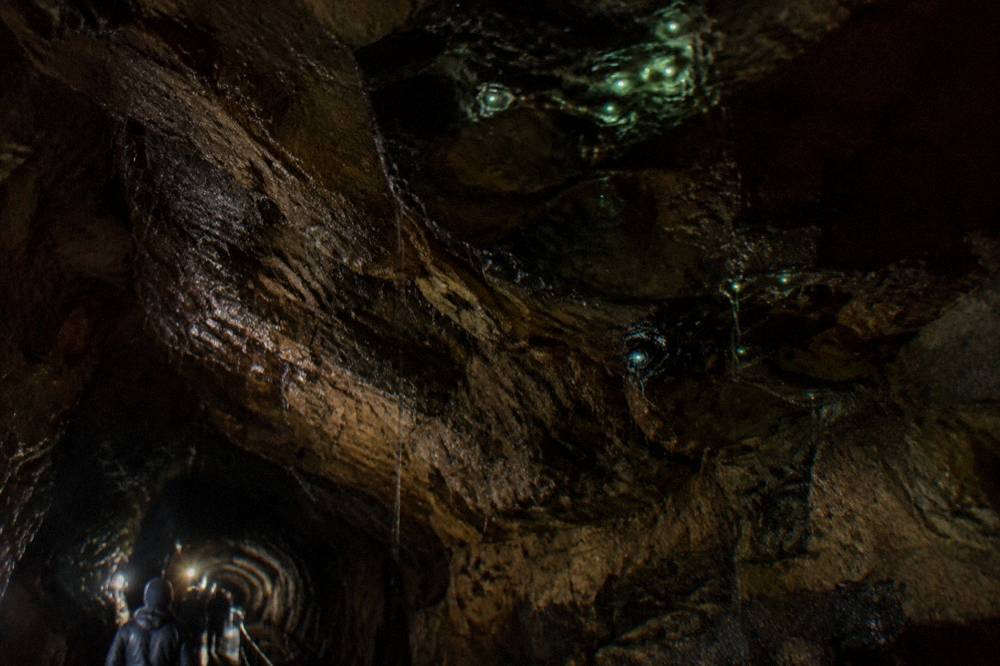
The best-known public colony near the Blue Mountains is in the Glow Worm Tunnel in Wollemi National Park, a 387 m abandoned railway tunnel about a 2.5 hour drive from Sydney, where the darkness is deep enough to see the larvae glowing even in daytime. The bookable option is a guided night hike from Sydney to a glow worm cave behind a waterfall, from $128 USD per person.
The tunnel at Newnes is the free, self-guided route, and the biology explains why it works so well. NSW National Parks notes that glow-worms need darkness, still moist air and running water nearby, and an abandoned rail tunnel supplies all three in permanent form, which is why its colony is stable enough to be a visitor attraction. The walk in is 6 km return from the carpark, and the tunnel's length is the trick: it gets dark enough in the middle that the larvae can be seen during the day, not only at night.
The guided alternative approaches the larvae from the other direction, at night and with red light. The Glow Worm Cave Night Hike From Sydney picks up from Sydney accommodation in a window from about 7:50pm to 8:35pm, drives a small group of at most nine travellers into the mountains, and walks in by headlamp to a cave behind a waterfall where native glow-worms can be seen. It runs about five hours, back around 11pm to midnight per the operator, with headlamps in red-light mode, water, parking fees and a certified outdoor instructor included. The listing carries a 4.9 rating from 210 reviews, and free cancellation up to 24 hours before. You can check the tour's full details or Check availability on the operator's live listing.
Two things are worth holding onto as a visitor. First, the operator does not publish the cave's location, and the hike is not a visit to the Newnes tunnel, they are different places. Second, glow-worms are wild, and no sighting is guaranteed: the operator cancels for bad weather or if minimum numbers are not met. What you are buying is a chance to stand in front of a working colony of larvae, with someone who knows how to approach them without switching their lights off.
Why Do Glow-Worms Switch Their Lights Off?
Because the glow is a hunting tool under the larva's control, disturbance makes it useless. NSW National Parks states that glow-worms can turn their lights off when disturbed, so torchlight pointed at them, loud noise or touch can darken a whole wall in minutes. That is the reason night walks use red light and stay quiet, and it is why visitors are told to look but not touch.
The sensitivity is chemical and behavioural at once. The light is produced on demand, so a larva that feels vibration, heat or bright light simply stops paying for it, and a colony that was a ceiling of stars goes black. NSW National Parks guidance built around this is specific: stay on the path, keep noise to a minimum, shine a torch at the ground or use a red-light option, and let your eyes adjust once the torch goes off. The operator's story for the Newnes tunnel adds that pointing a torch straight at the larvae can damage their bioluminescence and makes them switch off.
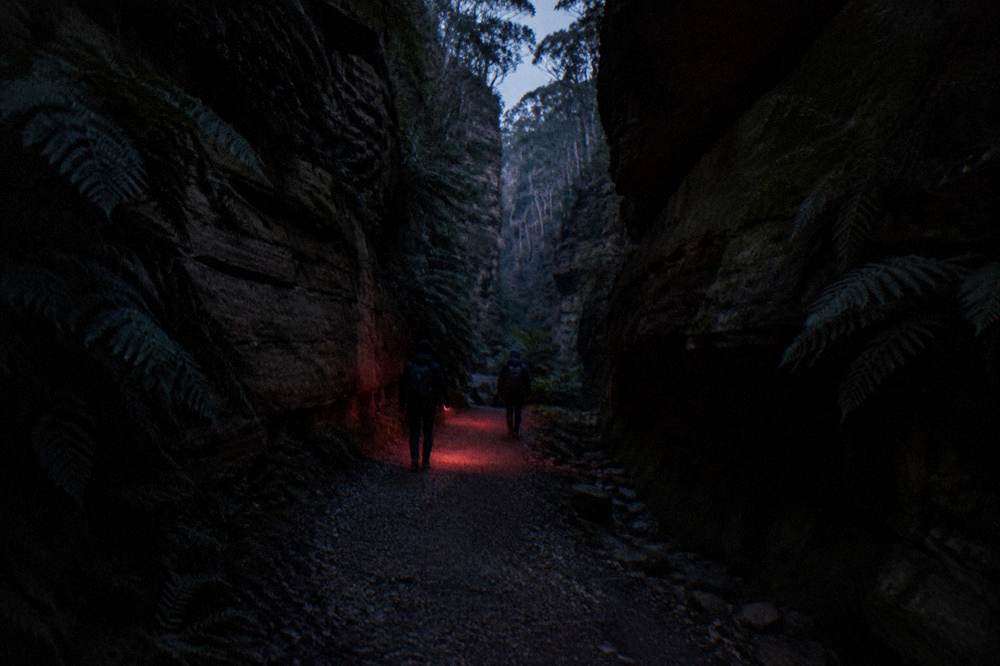
This is where the life cycle and good manners meet. The larva has six to nine months to grow, and every hour of darkness it loses to a careless torch is hunting time gone. The adult has three days and no light at all, so the colony's future depends entirely on the larvae being left alone to feed. Visitors who keep quiet and keep light low are not following empty etiquette, they are protecting the only glowing stage the species has. The blog piece on why you should never touch a glow-worm goes further into the do-not-touch rule.
The practical payoff is patience. After a torch is switched off or switched to red, eyes need time to adjust before the wall of lights reappears, and the larvae need time to decide the disturbance is over. Groups that rush in, chat loudly and sweep white light across the ceiling typically see nothing. Groups that wait in silence typically see the colony at full strength, which is the whole point of the trip.
Common Questions About Glow-Worm Life Cycles
What Does A Glow-Worm Turn Into?
A glow-worm turns into a small flying fungus gnat in the fly family. The glowing individual is the larva, which lives six to nine months before spinning a cocoon and pupating for about fourteen days. The adult fly that emerges does not glow, does not eat, and lives only about three days, long enough to mate and lay eggs.
Is a glow-worm a worm or an insect?
It is an insect. Glow-worms are the larval stage of fungus gnat flies, in the species Arachnocampa richardsae in the Blue Mountains and Wollemi National Park. The worm-like body is a juvenile form, not a worm, and the adult is a delicate fly resembling a large mosquito.
How long do glow-worms glow before they change?
The larva glows for the whole of its larval stage, which NSW National Parks gives as six to nine months. The light is used to lure prey into sticky silk snares. Once the larva pupates in its cocoon for about fourteen days, the glowing stage is effectively over, and the adult fly does not produce light.
Do adult glow-worm flies glow too?
No. The adult fungus gnat has no light-producing organ and does not feed. Its life is about three days long, spent mating and laying eggs near the colony it hatched from, which is why visitors only ever see the larval stage glowing on walls and ceilings.
Are glow-worms the same as fireflies?
No. Fireflies are beetles whose adults flash to attract mates. Glow-worms are fly larvae that glow to attract prey. Both produce light, but the glowing individual in a Blue Mountains cave is a juvenile fly hunting for food, not an adult beetle signalling for a partner.
Can you see the transformation happen on a tour?
Not the change itself, which happens inside a sealed silk cocoon over about fourteen days. What you can see is the larval stage glowing in colonies, either self-guided in the Glow Worm Tunnel near Lithgow or on a guided night hike from Sydney to a glow worm cave behind a waterfall. The pupae and adults stay hidden in the colony.